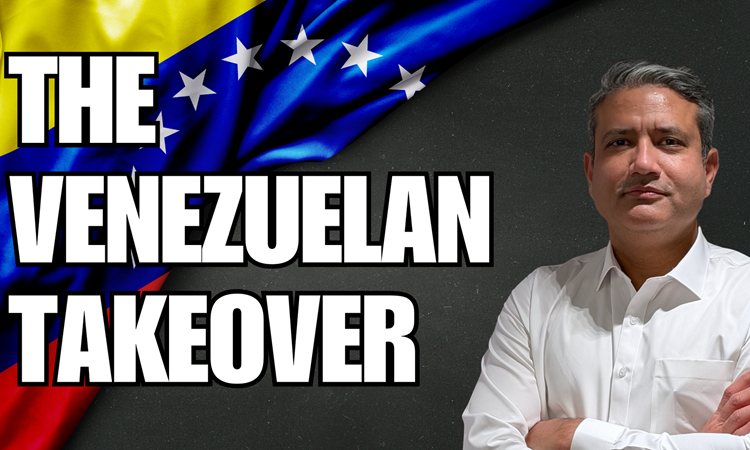
The global community has been taken by surprise by recent events. On January 3, 2026, the United States carried out large-scale military strikes and captured President Nicolás Maduro and his wife, flying them out of the country, according to U.S. officials.
In October 2025, we had shared our views on YouTube, where we explicitly stated that the next country the U.S. would invade would be Venezuela. The U.S. does not care about Venezuela; it cares about oil. With the effective return of the Monroe Doctrine, the United States is reasserting dominance over North and South America with an iron fist.
We understand the gravity of this statement. Unfortunately, this is the reality of the geopolitical world we inhabit.
We have also penned a detailed note on the investment implications of this takeover, drawing on insights from two of the sharpest global macro thinkers with a close ear to geopolitical developments:
Marko Papic, Partner and Chief Strategist at Clocktower Group. He previously founded the Geopolitical Strategy practice at BCA Research; the world's only dedicated investment consultancy focused solely on political analysis.
Jacob Shapiro, Director of Research at The Bespoke Group, where he advises families, investors, and corporations using a generational framework for capital preservation and growth.
The Chuck Norris Premium (US Invades Venezuela) - Geopolitical Cousins
What has unfolded in Venezuela is not unprecedented. It fits into a long historical pattern of actions by the U.S. Panama (1988-89), the Iraq invasion, and a series of Middle East interventions. What is different this time is the absence of ideological cover: there is no pretense of democracy promotion or human-rights justification.
Two distinct lines of thought emerge.
The first interpretation is that the U.S. has executed an exceptionally clean and successful operation without losing a single soldier. Such an outcome risks strategic overconfidence, potentially emboldening the U.S. to attempt similar operations elsewhere, whether in Iran or other Latin American countries. The early success in Afghanistan materially contributed to U.S. overreach across the Middle East (this did not end well).
The second interpretation is that the prolonged pressure campaign appears to have convinced the Venezuelan military that Maduro had become a liability, leading to coordinated internal cooperation. Under this view, other Latin American countries with weak institutions, internal factions, or elite fractures will now face heightened vulnerability, but this remains largely business as usual in the region. The broader geopolitical ripples may ultimately prove contained rather than transformational.
From an investment perspective, U.S. energy companies operating in the region, Chevron foremost among them, are clear beneficiaries. However, Venezuelan supply will take time to normalize given degraded infrastructure, heavy/sour crude characteristics, and capital constraints. Any incremental barrels are unlikely to materially depress global oil prices.
The true strategic and economic prize lies in Cuba, not Venezuela. Cuba offers a rare combination of underdeveloped real estate, tourism potential, and substantial natural resources (nickel, rare earths, and offshore oil). In that sense, Venezuela may be a precursor rather than the main event.
More broadly, Latin America is now effectively back under an explicit U.S. sphere of influence. The revival of the Monroe Doctrine should not be read as a signal of U.S. strength, but rather as an acknowledgment of constraint: a United States that can no longer exert uncontested power globally is choosing to consolidate control closer to home. For investors, this points toward structurally higher geopolitical risk premia, firmer commodity prices, and a world increasingly shaped by power politics rather than free trade.
Eastern Financiers, one of the first investment and financial consultant in Eastern
India have grown to become one of the largest investment consultants in the country.

 Login
Login





 Register on SCORES Portal LEDO