There is a reason what is SIP remains one of the most searched investment questions in India. A SIP, or Systematic Investment Plan, is simple, disciplined, and highly effective for long-term wealth creation, which is why monthly SIP inflows continue to grow strongly in 2026. For anyone searching for SIP investment for beginners, this is one of the easiest and most practical ways to start investing in mutual funds.
If you want to know how to start SIP in India, this guide explains everything in a clear, structured way. We will cover what SIP means, how it works, why it is ideal for beginners, and why many investors consider it the best sip investment plan for long-term goals.
What is SIP?
A SIP, or Systematic Investment Plan, is a way of investing a fixed amount in a mutual fund scheme at regular intervals, usually every month. If you are still asking what is SIP, think of it like a recurring investment habit that helps you build wealth gradually instead of investing a large amount all at once.
When you start a SIP of, say, ₹5,000 per month, that amount is automatically deducted from your bank account on a chosen date and invested into the selected mutual fund at the prevailing NAV. This is why many investors see SIP as the best sip investment plan for regular, long-term investing.
Why SIP is so popular
- It is simple to start and manage.
- It helps build financial discipline.
- It works well for long-term goals.
- It reduces the stress of market timing.
SIP Investment for Beginners
For anyone new to mutual funds, SIP investment for beginners is often the most suitable starting point. It allows you to begin with a small amount, stay consistent, and learn how investing works without taking unnecessary risk on day one.
Main benefits for beginners
- Start small
You can begin with a low monthly amount and increase it later as your income grows.
- No need to time the market
With SIP, you invest regularly regardless of market levels.
- Build discipline
A SIP helps create a habit of saving and investing every month.
- Benefit from compounding
The longer you stay invested, the more your returns can grow over time.
For these reasons, many advisors recommend SIP as the best sip investment plan for first-time investors who want a simple and goal-based approach.
How Does SIP Work?
Understanding what is SIP becomes easier when you see how it works in practice. Each time you invest a fixed amount, your money buys mutual fund units at the current NAV. When the market is high, you buy fewer units. When the market is low, you buy more units. Over time, this can reduce your average cost.
Example of rupee cost averaging
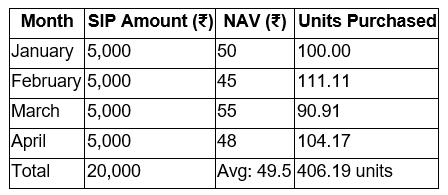
Your average cost per unit becomes ₹49.24, which is lower than the simple average NAV of ₹49.50. This is the power of rupee cost averaging and one of the strongest reasons why SIP investment for beginners works so well.
How to Start SIP in India
If you want to know how to start SIP in India, the process is straightforward and beginner-friendly. You do not need to be a market expert to begin.
- Step 1: Complete your KYC
You need basic identity verification using PAN, Aadhaar, and bank details.
- Step 2: Define your goal
Decide whether you are saving for retirement, a house, education, or wealth creation.
- Step 3: Choose the right fund
Pick a mutual fund based on your goal, risk tolerance, and investment horizon.
- Step 4: Decide the SIP amount
Start with an amount that fits your monthly budget comfortably.
- Step 5: Choose the SIP date
Select a date close to your salary credit or monthly income cycle.
- Step 6: Set up auto-debit
Once the SIP is active, the amount is automatically deducted every month.
If you are learning how to start SIP in India, the most important thing is to begin with an amount you can maintain consistently over time.
Why SIP is Ideal for Beginners
A SIP is usually considered the best sip investment plan for beginners because it removes several common barriers to investing.
- No market timing required
You do not need to wait for the “perfect” market entry.
- Disciplined saving
SIP turns investing into a habit instead of a one-time decision.
- Flexibility
You can pause, increase, decrease, or stop your SIP if needed.
- Long-term growth
Over time, compounding can help build a meaningful corpus.
- Tax-efficient options
ELSS SIPs can also help with tax savings under Section 80C.
This is why SIP investment for beginners remains one of the most recommended ways to enter mutual fund investing.
The Power of Compounding
One of the biggest advantages of SIP is compounding. The money you invest earns returns, and those returns can also start earning returns. Over a long period, this can create a powerful growth effect.
Illustrative SIP growth
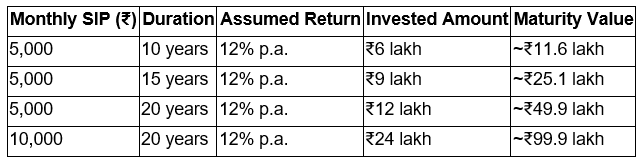
These numbers are illustrative, but they show why many investors view SIP as the best sip investment plan for long-term wealth creation.
Common SIP Mistakes to Avoid
Even though SIP is simple, beginners often make mistakes that reduce its effectiveness.
- Stopping SIP during market falls
This is usually the worst time to stop because market recoveries often happen later.
- Choosing too many funds
Three to five good funds are usually enough. Too many SIPs can create confusion.
- Not increasing the SIP amount
As your income rises, your SIP should also rise through a step-up approach.
- Investing without a goal
Every SIP should have a purpose, such as retirement, education, or home purchase.
- Ignoring charges and tax impact
Always check exit load and tax implications before redeeming early.
Avoiding these mistakes can make your SIP investment for beginners journey much smoother and more effective.
Final Thoughts
If you are still wondering what is SIP, it is one of the simplest and most effective ways to invest regularly in mutual funds. For anyone looking for SIP investment for beginners, it offers discipline, affordability, and long-term growth potential.
If you are trying to understand how to start SIP in India, begin with a clear goal, choose the right fund, and invest an amount you can continue every month. The best sip investment plan is not the largest one - it is the one you can stay consistent with for the long term.
Start small, stay disciplined, and let time and compounding do the work.
Start your SIP journey with Eastern Financiers. Use our free SIP Calculator at easternfin.com or speak to our advisors today.
FAQ's
Q. What is SIP in mutual funds?
A. SIP stands for Systematic Investment Plan. It is a method of investing a fixed amount in a mutual fund at regular intervals, usually every month.
Q. Why is SIP good for beginners?
A. SIP is good for beginners because it is simple, affordable, and disciplined. It helps people start investing with small amounts and reduces the pressure of timing the market.
Q. How does SIP work?
A. With SIP, a fixed amount is automatically invested on a chosen date. When markets are high, you buy fewer units, and when markets are low, you buy more units, which supports rupee cost averaging.
Q. How do I start a SIP in India?
A. To start a SIP in India, complete your KYC, choose a mutual fund scheme, decide the SIP amount, select a date, and set up auto-debit from your bank account.
Q. What is the minimum amount to start a SIP?
A. Many mutual funds allow SIPs to start with a small monthly amount, often as low as 500, though the minimum amount depends on the scheme.
Q. Is SIP better than investing a lump sum?
A. SIP is often better for regular income earners and volatile markets because it spreads out the investment over time. Lump sum can work well when you have surplus money and market valuations are attractive.
Q. Can I pause or stop a SIP anytime?
A. Yes, most SIPs are flexible and can usually be paused, modified, or stopped depending on the mutual fund platform and scheme rules.
Q. What are the common mistakes to avoid in SIP investing?
A. Common mistakes include stopping SIPs during market falls, investing without a goal, choosing too many funds, and failing to increase SIP amounts as income grows.

 Login
Login






 Register on SCORES Portal LEDO