Not every investor is comfortable with the full volatility of pure equity funds. And not every investor should be. A hybrid fund offers an elegant middle path - a blend of equity and debt that can deliver returns better than fixed deposits while cushioning the impact of equity market downturns. In 2026, with equity markets in a phase of consolidation and fixed income yields remaining attractive, hybrid mutual funds have become even more relevant for many types of investors.
If you are looking for the best hybrid mutual fund options in 2026, this guide will help you understand the types, taxation, and suitable categories for different goals. We have kept the original structure intact while improving keyword placement, readability, and SEO strength. We have also included the best balanced funds and other hybrid categories that may suit conservative, moderate, and long-term investors.
Why Hybrid Funds Matter in 2026
A hybrid fund is designed for investors who want both growth and stability. Instead of putting all the money into equity, the fund manager also allocates a portion to debt or other asset classes. This mix helps manage volatility while still aiming for long-term capital appreciation.
In 2026, many investors are choosing hybrid mutual funds because they want a smoother investment journey. Pure equity can be rewarding, but it can also feel stressful during market declines. A hybrid structure often feels more manageable, especially for beginners, retirees, and investors with medium-term goals.
Why investors prefer hybrid funds
- They offer diversification in a single investment.
- They can reduce portfolio volatility.
- They are suitable for medium-risk investors.
- They may deliver better returns than traditional fixed income products.
Types of Hybrid Mutual Funds
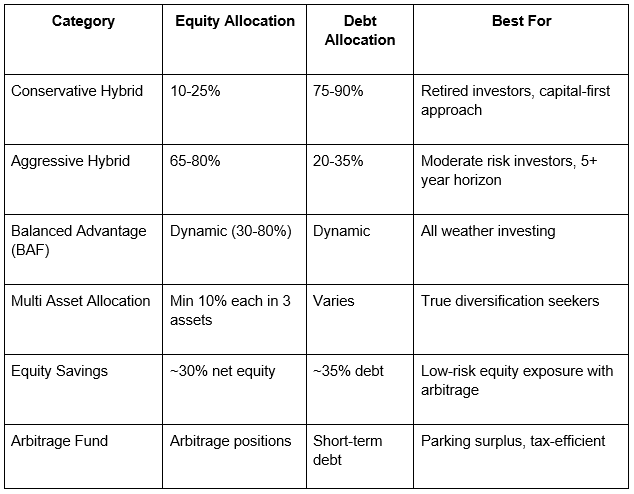
Different hybrid mutual funds serve different investor needs. Some are more equity-heavy, while others focus more on debt and capital protection. Choosing the right hybrid fund depends on your risk appetite and time horizon.
Conservative Hybrid Funds
These funds usually hold 75% to 90% in debt and 10% to 25% in equity. They are best for investors who want stability first and growth second.
Aggressive Hybrid Funds
These funds generally hold 65% to 80% in equity and 20% to 35% in debt. They are suitable for investors who want stronger equity participation with some downside protection.
Balanced Advantage Funds
Also called dynamic asset allocation funds, these funds shift between equity and debt based on market conditions. For many investors, these are among the best balanced funds because they automatically adjust exposure.
Multi Asset Allocation Funds
These funds invest across at least three asset classes, such as equity, debt, and gold. They are ideal for investors who want broader diversification.
Equity Savings and Arbitrage Funds
These options are generally used for lower-risk exposure, short-term parking, or tax-efficient allocation.
Best Aggressive Hybrid Funds 2026
Aggressive hybrid funds maintain a higher equity allocation while still keeping a debt cushion. This makes them a strong option for investors who want the growth potential of equity with some stability.
These funds maintain 65-80% in equity, qualifying for equity taxation (LTCG at 12.5% above ₹1.25 lakh after 1 year). Suitable for investors wanting equity growth with some stability.
- HDFC Balanced Advantage Fund - Largest fund by AUM in the hybrid category; dynamic asset allocation with strong track record
- ICICI Prudential Equity & Debt Fund - Experienced fund management; has navigated multiple market cycles effectively
- SBI Equity Hybrid Fund - Consistent performer; conservative equity selection with quality bias
- Mirae Asset Aggressive Hybrid Fund - Relatively newer but quality-driven approach
A good hybrid fund in this category may suit someone with a 5-year horizon or more. For investors who want more equity participation without going fully aggressive, these are among the best hybrid mutual funds to consider.
Best Balanced Advantage Funds (BAF) 2026
BAFs dynamically shift between equity and debt based on market valuations - they buy more equity when markets are cheap and reduce equity when markets are expensive. This makes them one of the most investor-friendly products for those who struggle with market timing decisions.
- ICICI Prudential Balanced Advantage Fund - Pioneer of the BAF category; internally manages 100+ crore AUM
- Edelweiss Balanced Advantage Fund - Strong quantitative model for asset allocation
- Nippon India Balanced Advantage Fund - Competitive model with good risk-adjusted returns
- Kotak Balanced Advantage Fund - Disciplined, model-based allocation with low expense ratio
If you are searching for the best hybrid mutual fund that adjusts automatically to market conditions, BAFs are one of the strongest choices available. These are also widely considered among the best balanced funds because of their valuation-driven approach.
Best Conservative Hybrid Funds 2026
With 75-90% in debt instruments and 10-25% in equity, these funds aim to generate slightly better returns than debt funds while maintaining capital stability. Ideal for retired investors or those close to their financial goals.
- ICICI Prudential Regular Savings Fund
- Kotak Debt Hybrid Fund
- SBI Conservative Hybrid Fund
These funds may not be the most aggressive, but they can be useful for investors who want a simpler and calmer hybrid fund experience.
Taxation of Hybrid Funds: What You Need to Know
Tax treatment of hybrid funds depends on the equity allocation:
- Equity-oriented hybrids (equity > 65%) - STCG at 20%, LTCG at 12.5% (above ₹1.25 lakh) after 1 year
- Debt-oriented hybrids (equity < 65%) - Gains added to income and taxed at slab rate
- BAFs typically qualify as equity funds for taxation purposes
This tax structure is one reason many people search for the best hybrid mutual fund before choosing where to invest. For many investors, tax efficiency is another reason why hybrid mutual funds remain attractive in 2026.
Who Should Invest in Hybrid Funds ?
A hybrid fund may be suitable for:
- First-time equity investors looking for a gentler introduction to market-linked returns
- Conservative investors who want returns better than FDs without high risk
- Retired investors seeking regular income with some growth
- Investors with a 3-7 year horizon who find pure equity too volatile
- Anyone looking for a single-fund 'all-in-one' investment solution
For many of these investors, hybrid mutual funds are the right compromise between safety and growth.
Final Thoughts
In 2026, hybrid mutual funds continue to be one of the most practical choices for investors who want balance, flexibility, and reduced volatility. Whether you choose an aggressive option, a conservative option, or one of the best balanced funds, the key is to match the fund with your own risk profile and financial goal.
A well-chosen hybrid fund can be a powerful part of a diversified portfolio. If you want a smoother investment experience with better growth potential than fixed deposits, the best hybrid mutual fund for you may be a balanced advantage fund, an aggressive hybrid, or a conservative hybrid depending on your needs.
Find the right hybrid fund for your goals and review your risk profile before investing.
FAQ's:-
What are hybrid mutual funds?
Hybrid mutual funds are investment funds that combine equity and debt in one portfolio to offer a balance of growth and stability.
Which is the best hybrid mutual fund in 2026?
The best hybrid mutual fund in 2026 depends on your risk profile, but Balanced Advantage Funds and aggressive hybrid funds are often strong choices for many investors.
Who should invest in hybrid mutual funds?
Hybrid mutual funds are suitable for first-time investors, conservative investors, retirees, and people with a 3 to 7 year investment horizon.
What are the types of hybrid mutual funds?
The main types are conservative hybrid funds, aggressive hybrid funds, balanced advantage funds, multi asset funds, equity savings funds, and arbitrage funds.
Are balanced advantage funds better than aggressive hybrid funds?
Balanced advantage funds are better for investors who want dynamic allocation, while aggressive hybrid funds are better for those who want higher equity exposure.
Why are hybrid funds popular in 2026?
They are popular because they offer a middle path between equity and debt, making them attractive in uncertain market conditions.
Can beginners invest in hybrid mutual funds?
Yes, hybrid mutual funds are a good starting point for beginners because they offer lower volatility than pure equity funds.

 Login
Login






 Register on SCORES Portal LEDO