India's mutual fund industry has crossed a major milestone, with Assets Under Management (AUM) surpassing ₹65 lakh crore in early 2026. This growth shows the increasing trust that Indian investors have placed in mutual funds as a long-term wealth creation option. With equity markets stabilising after the volatility of 2024–25, 2026 has become an important year for investors looking for the best mutual funds in India across different risk profiles.
But with more than 1,500 schemes available across categories, choosing the right fund can be overwhelming. That is why investors searching for mutual funds to invest in 2026 should focus on consistency, fund manager experience, expense ratios, and risk-adjusted returns rather than short-term market noise. In this article, Eastern Financiers has curated a list of the top mutual funds in India and the best performing mutual funds based on a disciplined selection framework.
Why Mutual Funds Remain the Go-To Investment in 2026
Mutual funds continue to be one of the most preferred investment choices for long-term wealth building. SIP registrations in India have crossed 10 crore active accounts, and monthly SIP inflows have remained above ₹25,000 crore, reflecting strong investor confidence. For people looking for the best mutual funds in India, the current market environment offers attractive opportunities.
Several macroeconomic factors are supporting equity mutual funds in 2026. India's GDP growth is projected at 6.6% for FY27, corporate earnings are recovering in key consumption and banking sectors, inflation is easing due to lower food prices and stable crude oil, and government capex in infrastructure and manufacturing is creating new opportunities for growth-oriented investors. These factors make 2026 a strong year for disciplined investors seeking the best performing mutual funds and well-diversified portfolios.
For most investors, the goal is not just to pick a fund, but to identify the mutual funds to invest in based on financial goals, time horizon, and risk appetite.
Best Large Cap Mutual Funds 2026
Large cap funds invest at least 80% of their corpus in the top 100 companies by market capitalisation. These funds are generally more stable and are suitable for conservative equity investors who want exposure to quality businesses with established track records. If you are looking for the top mutual funds in India with relatively lower volatility, large cap funds are often a solid starting point.
Large Cap Funds List
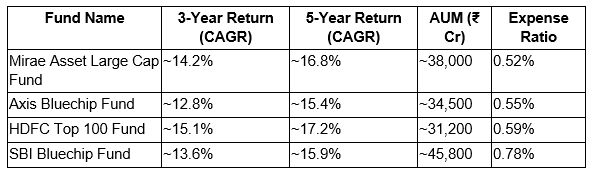
Large cap schemes are often considered among the best mutual funds in India for conservative investors who want long-term stability. While they may not always deliver the highest returns in the short term, they often provide reliable performance and lower risk compared to mid cap or small cap categories.
Best Mid Cap Mutual Funds 2026
Mid cap funds have delivered strong performance over the past five years, supported by India's expanding domestic consumption story and the rise of new-age businesses. These funds can be more volatile, but they are often among the best performing mutual funds for patient investors with a longer investment horizon.
Mid Cap Funds List
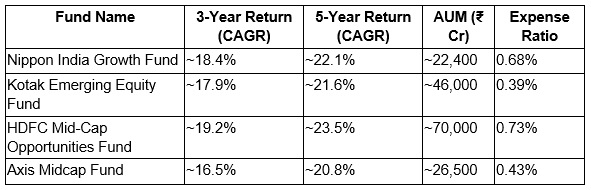
For investors who can tolerate moderate volatility, mid cap funds are strong candidates among the mutual funds to invest in for long-term growth. These schemes are suitable for wealth creation when held over a 5- to 7-year horizon or longer.
Best Flexi Cap Mutual Funds 2026
Flexi cap funds offer fund managers complete freedom to allocate across large cap, mid cap, and small cap segments. This makes them one of the most versatile categories in mutual fund investing and a popular choice among investors searching for the top mutual funds in India.
Best Flexi Cap Options
- Parag Parikh Flexi Cap Fund
Known for its international exposure and quality-focused investment approach.
- Quant Flexi Cap Fund
A data-driven, high active-share fund with strong recent performance.
- HDFC Flexi Cap Fund
A well-diversified scheme managed by an experienced investment team.
- Canara Robeco Flexi Cap Fund
A consistent risk-adjusted performer with disciplined portfolio construction.
Flexi cap funds are often included in lists of the best mutual funds in India because they give fund managers the freedom to adapt to changing market conditions. This flexibility can help investors balance growth and stability within a single scheme.
Best Small Cap Mutual Funds 2026
Small cap funds are suitable for investors with a high risk appetite and a minimum investment horizon of seven years. These schemes can be highly rewarding over the long term, which is why they are often discussed among the best performing mutual funds in high-growth market phases.
Small Cap Funds List
- SBI Small Cap Fund
One of the most consistent performers in the category.
- Nippon India Small Cap Fund
The largest AUM in the small cap segment.
- Quant Small Cap Fund
An aggressive, high-return fund for informed investors.
- Axis Small Cap Fund
A quality-focused scheme that invests in businesses at reasonable valuations.
Small cap funds are not ideal for everyone, but for investors who can stay invested through volatility, they can be powerful mutual funds to invest in for long-term capital appreciation.
How to Choose the Right Fund
Selecting the right mutual fund involves more than looking at past returns. Even the best mutual funds in India need to match your financial goals, risk level, and investment horizon. A fund that works well for one investor may not be suitable for another.
A Simple Selection Framework
- Define your financial goal
This could be retirement, child education, home purchase, or wealth creation.
- Determine your investment horizon
Short-term means under 3 years, medium-term is 3 to 7 years, and long-term is 7 years or more.
- Understand your risk tolerance
Use a risk profiler before choosing between large cap, mid cap, flexi cap, or small cap funds.
- Evaluate consistency
Look at rolling returns instead of point-to-point performance alone.
- Check expense ratio and exit load
These directly affect your long-term returns.
- Assess the fund manager's track record
Experience, philosophy, and consistency matter in category selection.
This framework helps investors identify the top mutual funds in India that fit their objectives instead of chasing random fund rankings. It also ensures that your investment choice stays aligned with long-term financial planning.
Final Thoughts
In 2026, mutual funds remain one of the most practical and effective ways to build wealth in India. Whether you prefer the stability of large cap funds, the growth potential of mid cap funds, the flexibility of flexi cap funds, or the high-return potential of small cap funds, there are strong options available for every investor profile.
If you are searching for the best mutual funds in India, focus on consistency, suitability, and long-term strategy rather than short-term market excitement. The most reliable mutual funds to invest in are the ones that match your goal, horizon, and risk comfort. By following a disciplined approach, you can identify the top mutual funds in India and choose from the best performing mutual funds for your portfolio.
Want personalised mutual fund recommendations? Connect with Eastern Financiers today. Visit www.easternfin.com or call us at +91-6292274300.
FAQ's
Q. What are the best mutual funds in India in 2026?
A. The best mutual funds in India in 2026 depend on your financial goals, time horizon, and risk appetite. Focus on consistency, fund manager experience, expense ratio, and risk-adjusted returns instead of only looking at past returns.
Q. How do I choose the right mutual fund for my goals?
A. Choose a mutual fund by first defining your goal, then matching the fund category to your investment horizon and risk tolerance. Also check consistency, expense ratio, and the fund manager's track record.
Q. Which mutual fund category is best for long-term wealth creation?
A. Equity mutual funds such as flexi cap, mid cap, and small cap funds are commonly used for long-term wealth creation. The right category depends on how much volatility you can handle and how long you plan to stay invested.
Q. Are large cap funds safer than mid cap and small cap funds?
A. Large cap funds are generally more stable because they invest in larger, established companies. Mid cap and small cap funds may offer higher growth potential but usually come with more volatility.
Q. What should I check before investing in a mutual fund?
A. Before investing, check the fund's performance consistency, expense ratio, portfolio quality, fund manager experience, and whether the fund matches your financial goal and time horizon.
Q. Is it better to invest in one fund or multiple funds?
A. For most investors, a small number of well-chosen funds is better than holding too many schemes. Over-diversification can create confusion without improving results.
Q. How often should I review my mutual fund portfolio?
A. Review your mutual fund portfolio periodically, such as once or twice a year, or when your goals, income, or risk profile changes. Avoid reacting to short-term market noise.

 Login
Login






 Register on SCORES Portal LEDO