Retirement planning is not a topic reserved for people in their 50s. It is one of the most important financial decisions you will make, and the earlier you start, the better the outcome. If you are looking for the best retirement plans, a SIP in equity mutual funds is one of the most practical ways to build long-term wealth and create the retirement plan that can support your lifestyle for decades.
India’s working population is still under-prepared for retirement, with many people depending only on EPF, gratuity, or family support. That is no longer enough. With the right mix of SIPs and well-chosen retirement funds, you can build a retirement corpus that is flexible, inflation-aware, and designed to last.
Why Retirement Planning Cannot Wait
Retirement planning works best when you start early. A delay of even 5 years can increase the amount you need to invest every month by a large margin. That is why the best retirement plans are not just about where you invest, but also when you start.
The retirement reality check
- Life expectancy in India is rising.
- Inflation can double your expenses over time.
- Healthcare costs rise faster than regular inflation.
- EPF and gratuity are helpful, but rarely sufficient.
- Younger generations cannot rely on traditional family support systems.
This means the retirement plan you choose must create enough wealth to cover 20 to 25 years or more after you stop working.
How Much Corpus Do You Need?
A common retirement planning rule is the 25x rule. It suggests that your retirement corpus should be about 25 times your annual expenses at retirement. This gives you a rough target for the retirement plan you need to build.
Example
If your monthly expense today is ₹50,000 and you retire in 20 years, inflation will likely raise that amount significantly. At 6% inflation, your monthly expense at retirement may be around ₹1.6 lakh, or ₹19.2 lakh per year. Your target corpus could then be approximately ₹4.8 crore.
That is why many investors search for the best retirement plans early in life, because long-term compounding makes large goals much more achievable.
SIP to Build Retirement Corpus
A Systematic Investment Plan is one of the strongest ways to build long-term retirement wealth. SIPs bring discipline, consistency, and compounding together in one simple structure. When paired with carefully chosen retirement funds, they can become the backbone of the retirement plan you follow.
SIP illustration for retirement
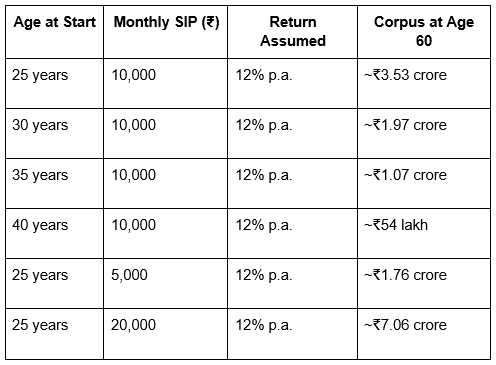
Starting 5 years earlier can nearly double your corpus. That is why SIPs are often included in the best retirement plans for long-term investors.
The Ideal Retirement SIP Strategy
A retirement journey works best in phases. Your equity exposure should be higher when you are younger and gradually reduce as you approach retirement. This makes your use of retirement funds more structured and lower risk over time.
Phase 1: Accumulation
Age 25-50
Focus on high-growth equity funds.
Suggested asset mix
- 40% Large Cap or Index Funds.
- 30% Mid Cap Funds.
- 20% Flexi Cap or Multi Cap Funds.
- 10% International or Global Funds.
This phase is about growth, discipline, and compounding. For many investors, this is where the retirement plan begins to take shape.
Phase 2: Consolidation
Age 50-55
Start shifting gradually towards balanced and hybrid funds. Reduce higher-risk exposure and begin building a debt buffer. This helps protect the gains already created by your retirement funds.
Phase 3: Near Retirement
Age 55-60
Move 40-50% of your portfolio into debt and hybrid funds. At this stage, a more conservative mix becomes important. You can also begin preparing for an SWP, or Systematic Withdrawal Plan, which can generate regular income after retirement.
Phase 4: Retirement
Once you retire, a mix of hybrid and debt funds can provide monthly withdrawals while keeping part of the corpus invested for inflation protection. Even during retirement, the retirement plan should preserve growth potential.
NPS vs SIP
Many investors compare NPS with SIP when evaluating the best retirement plans. Both are useful, but they serve different purposes.
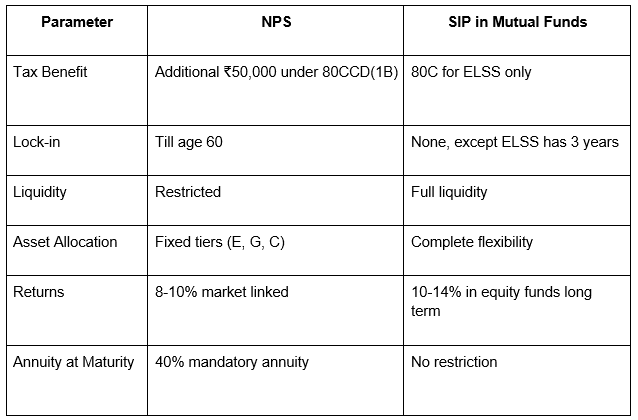
The practical approach is to use NPS for the extra tax benefit and SIPs in mutual funds as the primary retirement wealth builder. That combination often supports the retirement plan most effectively.
Best Retirement Fund Approach
When choosing retirement funds, think in terms of phases, flexibility, and inflation protection. The best retirement plans are not built on a single product. They are usually built using equity SIPs in the early years, hybrid or balanced funds in the middle years, and debt-oriented options near retirement.
Good fund categories for retirement planning
- Index funds.
- Large cap funds.
- Flexi cap funds.
- Balanced advantage funds.
- Aggressive hybrid funds.
- Conservative hybrid funds.
- Debt funds for stability near retirement.
Using the right mix of retirement funds can help you stay invested longer and reduce the risk of outliving your savings.
Common Retirement Planning Mistakes
Even a good plan can fail if investors make basic mistakes.
Mistakes to avoid
- Starting too late.
- Relying only on EPF.
- Taking too much equity risk near retirement.
- Not increasing SIPs as income rises.
- Ignoring healthcare inflation.
- Withdrawing too early from long-term investments.
The best retirement plans are consistent, realistic, and reviewed regularly.
Final Thoughts
Retirement planning is not only about saving money. It is about creating freedom, dignity, and stability for the rest of your life. If you want the retirement plan that can truly last, start early, invest consistently, and choose the right mix of equity, hybrid, and debt retirement funds.
For most investors, the best retirement plans combine SIP discipline, long-term growth, and gradual de-risking as retirement approaches. The earlier you begin, the easier it becomes to build a corpus that lasts a lifetime.
Start planning your retirement today with Eastern Financiers and use your SIPs wisely.
FAQ's:-
What are the best retirement plans in India?
The best retirement plans in India usually combine SIPs, equity mutual funds, hybrid funds, debt funds, and NPS to build long-term retirement wealth with flexibility and inflation protection.
How can SIPs help in retirement planning?
SIPs help retirement planning by building wealth gradually through disciplined monthly investing and the power of compounding over time.
When should I start retirement planning?
You should start retirement planning as early as possible, ideally in your 20s or 30s, so your money gets more time to grow.
Can I build retirement wealth with small SIPs?
Yes, even small SIPs can build a large retirement corpus over time if you stay invested consistently for many years.
Should I stop equity investing before retirement?
You should gradually reduce equity exposure near retirement, but keeping some equity can help protect against inflation over the long term.
Are retirement funds tax efficient?
Some retirement investments like NPS and ELSS offer tax benefits, while others may be taxed based on their category and holding period.

 Login
Login






 Register on SCORES Portal LEDO