Market Overview & Outlook
The Indian financial markets are navigating a period of contrasting domestic resilience and external uncertainty. Strong structural growth indicators-including healthy GDP expansion, robust GST collections and sustained Services PMI momentum-continue to support the domestic economy. However, these positives are being counterbalanced by heightened geopolitical risks, temporary capital reallocations and a structural shift in banking-system liquidity.
India Inc. began FY27 on an encouraging note, delivering a resilient Q1 performance despite persistent global headwinds. While topline growth remained healthy, elevated input and operating costs weighed on operating profit growth, limiting the pace of earnings expansion.
Meanwhile, ongoing geopolitical tensions in the Middle East, elevated crude oil prices and shifting expectations around the US interest-rate trajectory have kept Indian markets volatile. The introduction of the Closing Auction Session (CAS) in early August has added another layer of end-of-day volatility.
Despite the volatility in the secondary market, the primary market has gained significant momentum in H1 FY27. After raising just ₹22,573 crore between January and June 2026, IPO fundraising surged to nearly ₹49,592 crore during July–August. Average listing gains also improved sharply to 25% from 7.5% in Q1 FY27, reflecting strong investor participation and risk appetite. Looking ahead, H2 FY27 is expected to remain active, with the sizeable IPO pipeline potentially driving ₹60,000 crore to over ₹2 lakh crore of fresh equity issuances. This strong primary-market momentum is diverting investor liquidity away from the secondary market, weighing on trading volumes.
On the liquidity front, the RBI’s concessional FCNR-B deposit swap window generated stronger-than-expected foreign-currency inflows, with total inflows from deposits and broader forex swaps exceeding $260 billion. This helped push foreign-exchange reserves above $700 billion, providing a substantial buffer against external shocks and rupee depreciation. Improved system liquidity has also supported bank balance sheets and contributed to healthy 17–18% credit growth.
However, the FCNR-B inflows also present a key caveat. These inflows represent largely temporary funding rather than a structural improvement in India’s external balances. As the deposits mature, refinancing and rollover risks could emerge, particularly if global interest rates remain elevated or the rupee comes under renewed pressure. A sharp reversal in global risk sentiment could therefore reduce the durability of the liquidity support.
The escalating Saudi-Houthi conflict poses risks to India’s energy and economic security, given Saudi Arabia’s ~10% share of India’s crude imports and its critical role in fertilizer supplies. The Gulf accounts for ~37% of India’s fertilizer imports, with Saudi Arabia contributing ~18%, including 32% of DAP (Diammonium Phosphate) and 42% of MOP (Muriate of Potash) imports. Prolonged disruptions could therefore drive higher crude and fertilizer costs, inflation and supply-chain pressures.
Overall, the market outlook remains cautiously constructive. Strong domestic fundamentals, healthy credit growth, resilient corporate performance and a buoyant primary market provide important support, while geopolitical uncertainty, crude prices, global monetary policy and the temporary nature of certain liquidity inflows remain key risks. In this environment, earnings visibility, balance-sheet strength and reasonable valuations are likely to become increasingly important drivers of stock selection rather than broad-based market momentum.
Macro Overview & Outlook
RBI and the many challenges on inflation front
Where CPI (Consumer Price Index) and core inflation stand
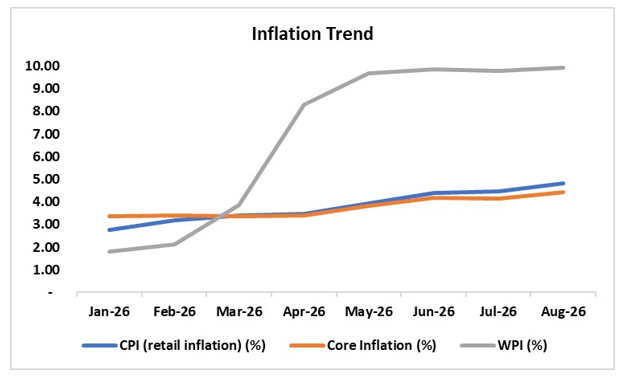
Retail (CPI) inflation rose to 4.82% in August, up from 4.45% in July, with rural inflation at 5.23% running well ahead of the urban inflation which is at 4.31%. Food inflation hit 5.66% on elevated onion, ginger, and garlic prices, while core inflation (ex food, fuel, household and transport) climbed to 4.44% from 4.15% - a sign price pressure is no longer confined to volatile food and fuel components and its broad-based. SBI Research’s own breadth analysis is the most telling data point here: in January 2026, just 22 commodities accounted for 90% of the CPI’s weighted move; by August, this had widened to 51 commodities, while the contribution of the top 25 commodities (excluding gold and silver) fell from 83% to 62%. This is a textbook signature of inflation “generalising” across the basket rather than remaining concentrated in a few items.
CPI vs WPI (Wholesale Price Index)- a widening wedge
The CPI print looks almost tame next to wholesale prices. India's WPI inflation rose to 9.92% year-on-year in August 2026, up from 9.78% in July, with fuel and power inflation accelerating to 22.93% from 20.05% and manufactured products inflation edging up to 8.37% from 8.29%. WPI has now stayed close to the 10% mark for four consecutive months. The SBI Research report flags the same divergence at the sub-component level: the CPI's electricity/gas/fuel component rose just 3.09% in August against a 22.93% WPI fuel-and-power print - meaning very little of the wholesale energy shock has actually been passed through to retail prices yet. That's the crux of the forward risk: a large pipeline of un-passed-through cost is sitting upstream, and it typically leaks into CPI with a lag through transport, restaurant, and manufactured-goods prices - exactly the categories (restaurants at 8.4%, transport at 4.6%) already accelerating. We have also highlighted the same and this also highlights margin risk for India Inc.
The Saudi pipeline disruption and why it matters for India
This is the fresh shock layered on top of an already-deteriorating base case. Saudi Arabia's 745-mile East-West pipeline - which normally lets the kingdom bypass the Strait of Hormuz - was struck by drones launched from Iraq on 10th September, following Houthi attacks from Yemen that had already hit Saudi energy facilities and injured more than 70 people in the preceding days. The pipeline, which normally moves an estimated 4-5 million barrels a day, was shut down with no ready alternative route, and Brent broke above $100 for the first time in months, closing the week over 8% higher; the IEA said Saudi crude supply fell to its lowest level in more than three decades. Regional officials indicated the pipeline will be mostly out of service for weeks while repairs are carried out, even as Houthi rebels continue seizing islands along key Red Sea shipping routes.
For India this compounds an already-visible channel: the Indian crude basket has jumped from $82/bbl in July to $90 in August to nearly $110 in September, and dated Brent is trading near $105.7. SBI Ecowrap highlights that with imported inflation already running at 7.75% YoY against 4.82% headline CPI in August- a sustained supply-side shock from the Saudi pipeline outage, on top of ongoing Red Sea disruption to shipping, raises the odds that pass-through accelerates through Q4 2026 and Q1 2027 rather than fading.
This has also threatened India’s fertiliser sector. The Gulf accounts for ~37% of India’s fertiliser imports, with Saudi Arabia contributing ~18%, including ~32% of DAP (Diammonium Phosphate) and ~42% of MOP (Muriate of Potash) imports. Liquefied natural gas (LNG) and sulphur, critical feedstocks for domestic urea and phosphate production, are also facing severe supply bottlenecks and rising costs. Thus, prolonged disruptions could therefore push up crude oil and fertiliser costs, adding to inflationary pressures and exacerbating supply-chain disruptions.
RBI's rate path and the challenges ahead
The RBI has been on hold at a 5.25% repo rate with a neutral stance since June, most recently reaffirmed at the August MPC, where Governor Sanjay Malhotra said the Committee wanted "greater clarity" on the inflation outlook before acting, and expected headline inflation to peak in the October-December quarter before easing, while flagging West Asia tensions, volatile crude, an uneven monsoon and global trade uncertainty as key risks. The next MPC meeting is scheduled for October 5-7, 2026.
However, the call for rate hikes are now getting louder with even the SBI report advocating 2 rate hikes of 25 bps each at both the October and December meetings, then a pause - would mark a genuine pivot from that neutral stance, and its reasoning has three legs: (1) inflation breadth has widened well beyond the RBI's comfort zone and core is now above 4%; (2) the crude/Saudi shock adds imported-inflation pressure that a rate hold can't offset; (3) global yields are repricing hard - the report notes the US 10-year has breached 5%, India's own 10-year benchmark is pushing toward 7.10% now with risk of 7.25% and then 7.50% - and holding rates while global term premia rise risks capital and currency pressure regardless of domestic conditions.
To top it, there is a growing clamour and increasing probability of rate hikes from US Federal Reserve and that would complicate matters further. While the RBI has cushioned the rupee with USD136 billion inflows from FCNR deposits. However, a problem which is structural in nature wouldn’t help the rupee from sliding further. This is challenging for the economy and the stock markets are probably having bouts of panic in between.
Stock Recommendations
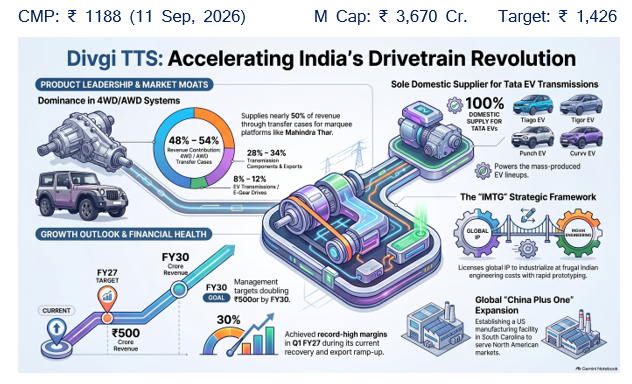
- Divgi TorqTransfer Systems Ltd.
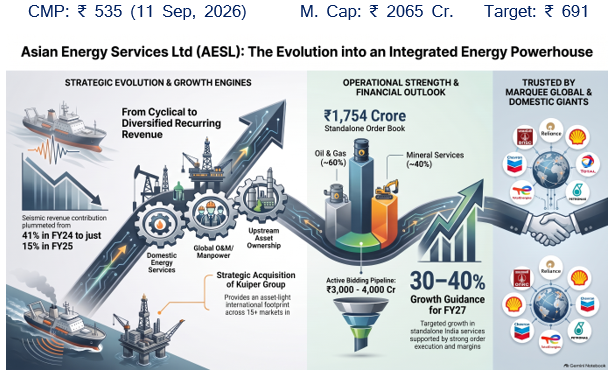
- Asian Energy Services Ltd.
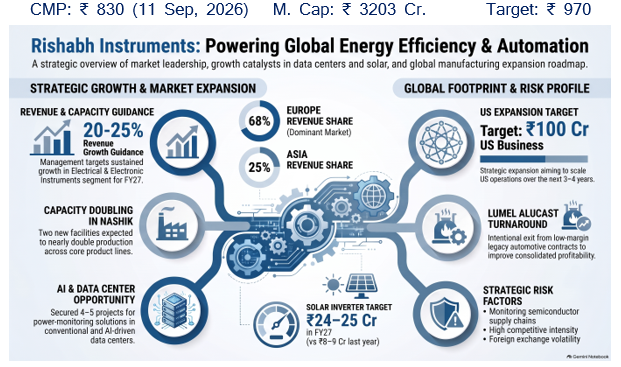
- Rishabh Instruments Ltd.
Performance Radar
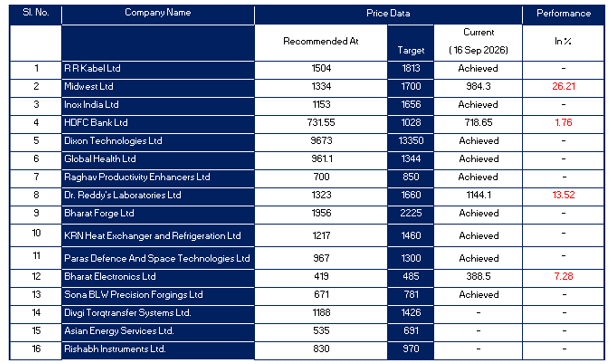
Research Team
Partha Mazumder (partha@easternfin.com)
Sanjukta Majumdar (research@easternfin.com)
Sayantina Mallick Chowdhury (sayantina@easternfin.com)
Disclaimer
Eastern Financiers Limited (hereinafter referred to as ‘EFL’) (RA Registration No: INH000022756, Type: Non-Individual) is a Member registered with SEBI having membership of NSE, BSE, MCX. It is also registered as a Depository Participant with NSDL. It is also having AMFI certificate for Mutual Fund Distribution. The associate of EFL is engaged in activities relating to Insurance Broking. No disciplinary action has been taken against EFL by any of the regulatory authorities. EFL/its associates/research analysts do not have any financial interest/beneficial interest of more than one percent/material conflict of interest in the subject company(s). EFL/its associates/research analysts have not received any compensation from the subject company(s) during the past twelve months. EFL/its research analysts have not served as an officer, director or employee of company covered by analysts and has not been engaged in market making activity of the company covered by analysts. This document is solely for the personal information of the recipient, and must not be singularly used as the basis of any investment decision.
Nothing in this document should be construed as investment or financial advice. Each recipient of this document should make such investigations as they deem necessary to arrive at an independent evaluation of an investment in the securities of the companies referred to in this document (including the merits and risks involved), and should consult their own advisors to determine the merits and risks of such an investment. Reports based on technical and derivative analysis centre on studying charts of a stock's price movement, outstanding positions and trading volume, as opposed to focusing on a company's fundamentals and, as such, may not match with a report on a company's fundamentals. The information in this document has been printed on the basis of publicly available information, internal data and other reliable sources believed to be true, but we do not represent that it is accurate or complete and it should not be relied on as such, as this document is for general guidance only. EFL or any of its affiliates/group companies shall not be in any way responsible for any loss or damage that may arise to any person from any inadvertent error in the information contained in this report. EFL has not independently verified the information contained within this document. Accordingly, we cannot testify, nor make any representation or warranty, express or implied, to the accuracy, contents or data contained within this document. While EFL endeavours to update on a reasonable basis the information discussed in this material, there may be regulatory compliance or other reasons that prevent us from doing so. The report is for information and education purposes only. It must not be construed as any solicitation of any investment or any BUY/ SELL/ HOLD recommendation. Investments are subject to market risk. The user must do his/ her own research before taking any investment decision. Eastern Financier Limited is not liable for any consequence of any action taken by the user on the basis of this report.

 Login
Login




 Register on SCORES Portal LEDO